Still Not Seeing The Right Packaging Solution? Talk to Our Boss.
If you’ve reviewed our website or spoken with sales and still don’t see a clear path, send your request here. Your message goes directly to our General Manager for an executive review of feasibility, cost, and lead time. You’ll get a clear next step—what we can do, what we need from you, and the fastest route to a quote.
Direct GM review of your specs, use case, and constraints
Print/finish recommendations to match brand + budget
Cost-down alternatives and lead-time improvement options
Quote path clarity: MOQ, sampling plan, and what to next
Talk to Our Boss
Get a Fast Quote for Custom Paper Tube Packaging
Built for packaging managers, procurement, and packaging engineers. Specify size, quantity, and finish to receive moq, lead time, and spec guidance for us/eu programs.
Quote-ready customization: diameter, height, wall thickness, inserts, liners, and closures
Discover the Innovative Features of Sushi Push Pop Tube Packaging
Most sushi packaging gets the job done.
And then it vanishes.
We have all seen it. A clamshell here. A tray there. Fine for basic takeaway. Not fine when you want the pack to sell the product before anyone takes the first bite.
That is why sushi push pop tube packaging keeps coming up in serious packaging conversations.
Not because it feels flashy. Because it fixes a few stubborn problems at once. Presentation. Portability. Sauce handling. Shelf impact. And it does all of that without looking like every other pack piled near the register.
Those points are not guesswork. Recyclability sits at the top of the list for U.S. consumers thinking about packaging sustainability, off-premises ordering stays common, and recyclability claims now face tighter scrutiny.
Table of Contents
Why this format is getting real traction
Look, we should start with the market, not the tube.
If buyers care about recyclability and customers keep ordering food to go, the pack has to carry more weight. It has to travel well. It has to look sharp. And it has to give you a better material story than a plain plastic tray.
That is exactly where this format starts to make sense.
And yes, the broader market backs this up too. Fortune Business Insights projects the sustainable food service packaging market at USD 75.87 billion in 2026, with growth to USD 134.72 billion by 2034. So when brands ask whether paper-forward food packaging still matters, our answer is simple.
It does. A lot.
The numbers buyers should actually pay attention to
Signal
Fresh data
What it means for sushi brands
Consumers care most about recyclability
77% of U.S. consumers rank recyclability as extremely or very important in packaging sustainability decisions
Lead with materials clarity, not vague eco language
Off-premises is routine
47% of adults pick up takeout weekly; 37% order delivery weekly
Packaging has to survive transport and still eat cleanly
Sustainable foodservice packaging is growing
Market projected at USD 75.87B in 2026 and USD 134.72B by 2034
Buyers have more options, but also more pressure to choose well
Recyclability claims are getting tighter
2025 guidance changed labels for some composite formats to “Check Locally”
Blanket “fully recyclable” claims are a bad bet on mixed-material packs
That table tells the story fast.
Here is the slower version. The format works when the structure works, the barrier works, and the claims stay honest. Miss any one of those, and the whole pitch starts to wobble.
What the best sushi push pop tubes get right
A paper-forward body with a real barrier story
Here’s the thing. A paper tube sounds simple until you actually spec one for sushi.
Now you are dealing with moisture. Aroma. Grease. Product appearance. A flimsy wall or a weak liner can ruin the whole idea fast.
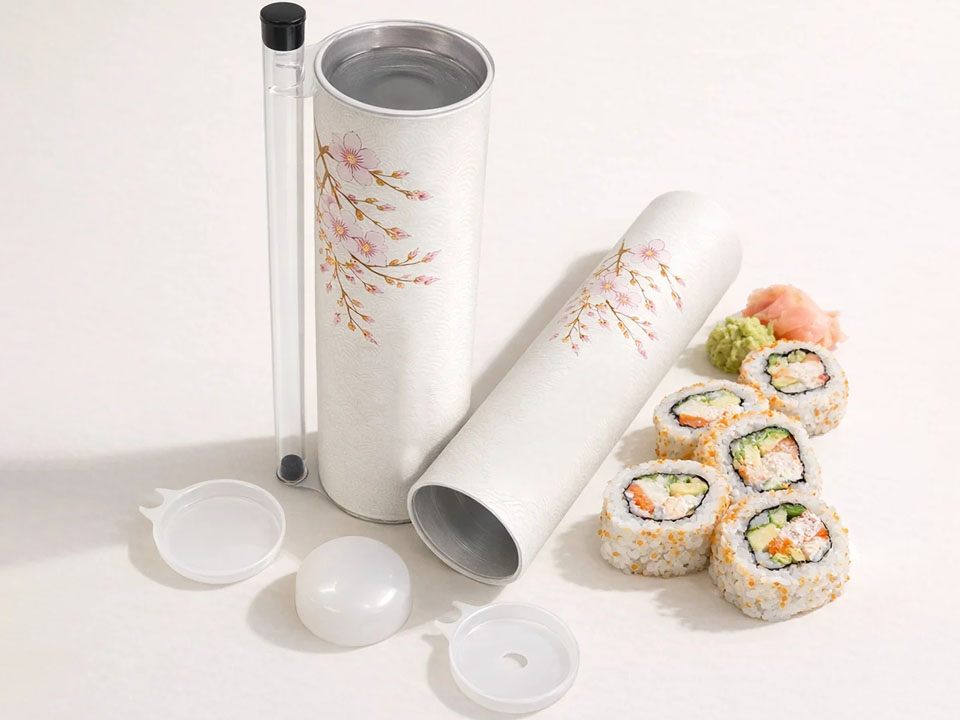
Your product page gets much closer to the real buyer conversation. It describes a food grade sushi push up tube with an aluminum foil lining that helps block light, gases, and moisture. It also states that multiple sizes fit nigiri, maki, and futomaki. That is useful because it connects the structure to the food, not just to a marketing slogan.
So no, we would not pitch this as “just a paper pack.”
The barrier layer matters. A lot.
A pop-up base that changes the eating moment
This is where the format stops being generic.
Press the base. The sushi rises to the rim. The first piece is easy to grab. Service feels cleaner. The pack feels smarter. Small move. Big difference.
We have noticed that this is the part buyers remember after a first demo. Not because it looks cute. Because it removes friction. Your product page says the pop up base is easy to carry, serve, and enjoy, and that lines up with why the format works in the first place.
And sure, there is a bit of theater in it.
But good packaging earns its theater.
Caps and sauce control that do not feel bolted on
Let’s be real. Sauce handling ruins a lot of “innovative” food packaging.
The competitor article mentions top and bottom caps, a soy sauce tube, and leak-proof screw caps. Fine. But it stops there, right at the feature list. That is where we would push harder. Sauce control is not a tiny detail. It changes cleanliness, freshness perception, and how premium the pack feels in hand. A bad cap fit makes the whole format feel cheap, even when the print looks expensive.
So the better question is not whether the format includes a sauce tube.
It is whether the supplier has tested that sauce tube in real handling conditions.
360° branding space beats a top sticker
A tray gives you a lid sticker.
A tube gives you a body.
That changes the conversation.
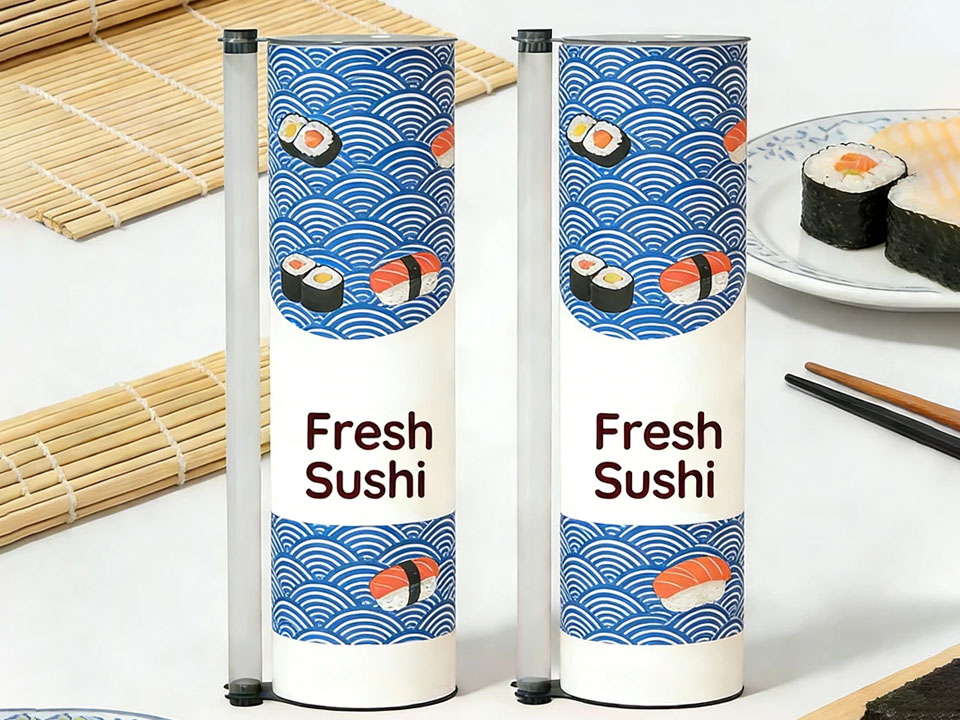
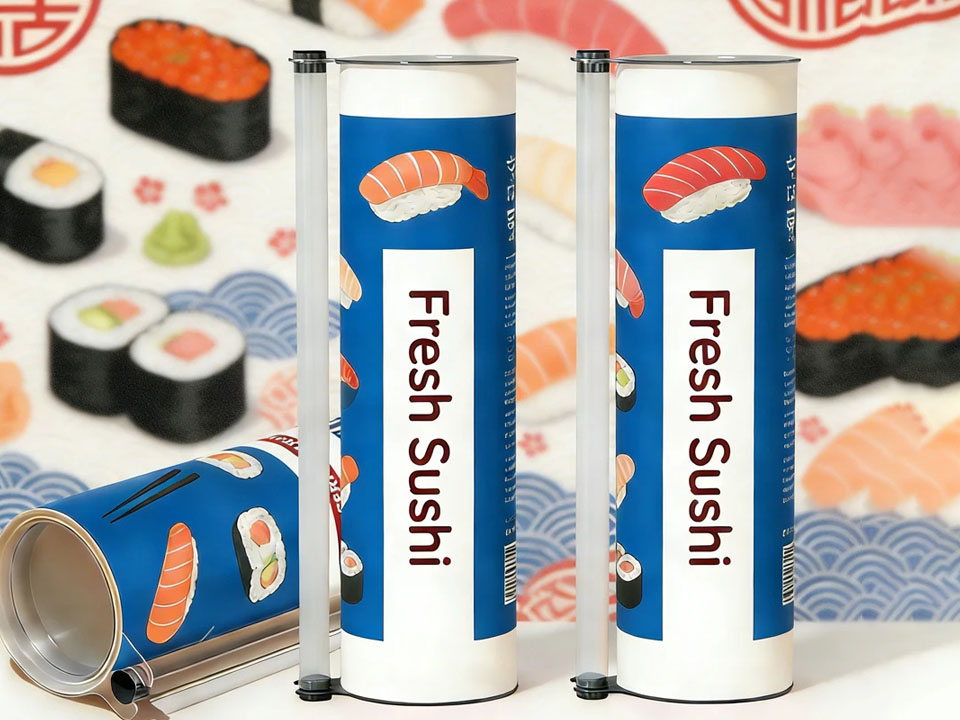
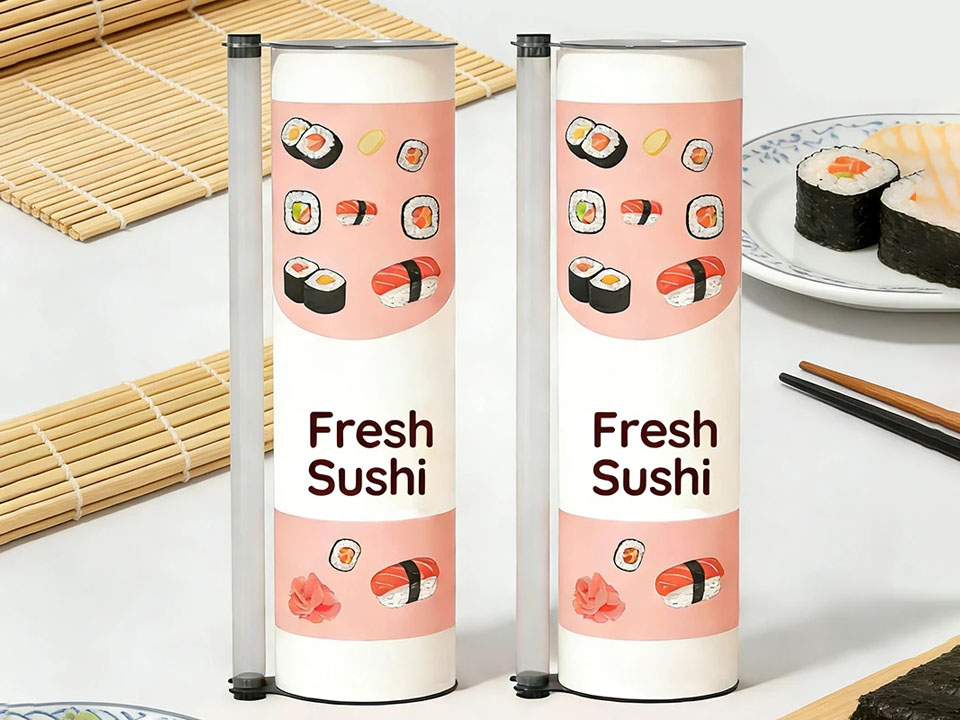
You get more room for graphics, story, color, limited-run art, promo copy, and a better premium feel without fighting for half an inch of label space. The competitor page talks about customization. Your product page supports custom printing and finish options. The stronger angle, in our view, is not “we can add your logo.” It is “we can turn the full structure into branded real estate.”
For brands that want a format already aligned with what buyers usually ask for, eco-friendly sushi push-pop paper tube boxes with soy sauce already check the right boxes: food-grade construction, foil lining, multiple sizes, pop-up dispensing, and custom print potential.
Where brands get themselves in trouble
“Fully recyclable” is where sloppy copy starts
This is the part where a lot of packaging copy falls apart.
The competitor says the paper tube is fully recyclable. That is too broad for a format that may involve paper, foil lining, and plastic components. How2Recycle’s January 2025 guidance moved some composite formats to “Check Locally.” And the Sustainable Packaging Coalition’s 2025 report says 2025 marks a watershed moment as states move to redefine what qualifies as recyclable. So when mixed-material packs are in play, broad claims can age badly. Fast.
We would say paper-forward.
We would say designed to reduce plastic use.
We would say check local recycling guidance when that is the honest answer.
That kind of wording sounds less flashy. It also sounds more credible.
Performance still decides repeat orders
Look, buyers can admire a concept and still reject it.
Why? Because performance still wins. It always does.
McKinsey points out that packaging purchasers still struggle to find newer materials that match traditional materials on performance, especially during transportation, storage, and shelving. For sushi, that hits home. Nobody cares how nice a render looks if the roll dries out, shifts inside the tube, or shows up looking tired after delivery.
That is why we keep coming back to the same unglamorous checklist.
In our experience, this format works best when the packaging has to do more than protect the food.
It fits premium grab-and-go sushi where the pack helps support price. It fits sampler sets where portion control and presentation matter. It fits takeaway and delivery programs where rigid walls can help the product arrive looking better. It also fits seasonal promos, limited-run drops, and even retail-ready gifting where vertical presentation adds a little perceived value without trying too hard. Those use cases line up with the supplier’s stated structure and the current off-premises ordering pattern.
Would we force this format into every sushi program?
No.
It is a weaker fit for ultra-low-cost menus where every cent matters, and it is not always the best answer for products that simply sit better in a flat tray.
A sourcing checklist before you ask for pricing
Before you send out RFQs, get these five points straight.
Tube diameter and fill height — the format has to fit the actual sushi build, not a rough guess. Your product page says multiple sizes are available for nigiri, maki, and futomaki, and that is exactly the kind of detail buyers should pin down early.
Barrier structure — ask what the liner is, what it protects against, and how it changes disposal claims. Foil can help performance, but it can also make recyclability language trickier.
Cap fit and sauce tube design — leaks destroy confidence fast. Treat the cap system like a core part of the pack, not an accessory.
Print and finish plan — decide early whether you want CMYK, Pantone matching, foil, embossing, spot UV, or a simpler route. Your product page already points to those customization paths.
Transit testing — ask for proof under real delivery conditions, not just mockups or beauty shots. McKinsey makes the performance issue pretty plain.
So where do we land on it?
Done right, sushi push pop tube packaging gives you stronger shelf presence, cleaner handling, better branding space, and a material story that fits where food packaging is heading. Done badly, it turns into expensive theater.
And the line between those two outcomes is not hype.
It is the spec sheet. The testing. And the honesty of the claims.