Vous n'avez toujours pas trouvé la bonne solution d'emballage ? Parlez-en à notre patron.
Si vous avez consulté notre site web ou discuté avec le service des ventes et que vous ne voyez toujours pas la voie à suivre, envoyez votre demande ici. Votre message sera transmis directement à notre directeur général, qui examinera la faisabilité, le coût et le délai de mise en œuvre. Vous obtiendrez une étape suivante claire - ce que nous pouvons faire, ce que nous attendons de vous, et la voie la plus rapide pour obtenir un devis.
Examen direct par GM de vos spécifications, cas d'utilisation et contraintes
Vérification de la taille et de la structure : diamètre, hauteur, résistance des parois, inserts
Recommandations en matière d'impression et de finition en fonction de la marque et du budget
Possibilités de réduction des coûts et d'amélioration des délais
Clarté du cheminement du devis : MOQ, plan d'échantillonnage et étapes suivantes
Parler à notre patron
Obtenir un devis rapide pour l'emballage de tubes en papier sur mesure
Conçu pour les responsables de l'emballage, de l'approvisionnement et les ingénieurs de l'emballage. Spécifiez la taille, la quantité et la finition pour obtenir un devis, un délai de livraison et des conseils sur les spécifications pour les programmes américains/européens.
Personnalisation prête à l'emploi : diamètre, hauteur, épaisseur de paroi, inserts, doublures et fermetures
Finitions haut de gamme : CMYK/Pantone, film, gaufrage, UV
Clarté de l'approvisionnement : spécifications claires + conseils en matière de contrôle de la qualité et de gestion des défauts de fabrication
Durable : Papier FSC® disponible sur demande
Sécurité enfants : conforme à la norme ISO 8317 / PPPA
Quelles sont les différences entre les différents types de tubes en papier ?
Table des matières
Les gens disent “tube en papier” comme s'il s'agissait d'une chose. Dans le domaine de l'emballage, c'est un peu comme commander du café. Il y a différentes constructions, différentes sensations et différentes performances une fois que le produit est expédié, transporté par voie maritime ou mis en rayon.
Qu'est-ce qui est vraiment différent ?
La plupart du temps, il s'agit de la façon dont le tube est enroulé, l'épaisseur du mur, et les finitions ou les inserts que vous ajoutez. Ces choix déterminent si votre tube reste croustillant après l'expédition, si le couvercle est bien serré (pas fragile) et si votre produit arrive sans aucun cliquetis.
Si vous souhaitez obtenir un aperçu rapide des styles de tubes par catégorie, commencez par la rubrique Produits page.
Tubes en papier enroulés en spirale
Tubes en papier enroulés en spirale utiliser des plis de papier enroulés en biais autour d'un mandrin. Cette construction est le cheval de bataille des boîtes de tubes pour la vente au détail, car elle est bien adaptée et couvre la plupart des contraintes d'expédition “normales”.
Pourquoi les marques choisissent-elles des tubes à enroulement spiralé ?
Lisse pour la production en vrac: Vous pouvez appliquer des spécifications cohérentes à l'ensemble des UGS sans transformer chaque commande en projet scientifique.
Une protection solide pour les envois quotidiens: Avec une épaisseur de paroi adéquate, les tubes spiralés supportent mieux la pression d'empilage et les chutes de carton que les boîtes pliantes.
Facile à habiller: Les enveloppes imprimées, le pelliculage mat et les détails en aluminium vous donnent une présence en rayon sans passer à une structure totalement différente.
Scénarios optimaux
Commerce électronique transfrontalier où le paquet est manipulé trop souvent
Boîtes d'abonnement où les éraflures et les bosses apparaissent rapidement
Lancement de produits de détail nécessitant une qualité reproductible d'un lot à l'autre
Tubes en papier à enroulement convexe
Tubes en papier enroulés en spirale (à enroulement parallèle), les couches de papier d'emballage sont plus “droites” le long de l'axe du tube. Les acheteurs choisissent généralement ce style lorsqu'ils sont soucieux de rigidité et un contrôle plus poussé ajustement du couvercle.
Pourquoi les tubes convolutés sont-ils différents ?
Une “sensation de main” plus rigide”: Idéal lorsque votre produit est dense ou que vous souhaitez un test de compression plus solide.
Meilleur contrôle de l'ajustement et de la finition: Si votre couvercle doit être précis, cette construction peut aider à réduire l'impression de “bouchon lâche”.
Scénarios optimaux
Des packs premium où l'expérience d'ouverture compte
Des objets plus lourds qui punissent les parois minces
Des couvercles bien ajustés là où l'on ne veut pas de flottement
Noyaux de papier et tubes à paroi épaisse
A noyau de papier est en fait un tube à parois épaisses conçu pour supporter une charge. Même si vous fabriquez des emballages destinés aux consommateurs, ce concept est important car les parois épaisses permettent de résoudre les problèmes courants : bosses, coins écrasés et retours.
Là où les tubes à parois épaisses gagnent leur vie
Empilage des cartons (la pression de l'entrepôt s'accroît)
Longues routes maritimes où les dommages dus à la compression se manifestent tardivement
Produits que les clients saisissent durement (fitness, suppléments, outils)
Si vous constatez des bosses à l'arrivée, ne vous contentez pas d'améliorer l'impression. Spécifiez le mur comme s'il s'agissait d'un noyau, puis stylisez l'extérieur pour la vente au détail.
Tubes en papier résistant à l'eau
Le papier et l'humidité ne font pas bon ménage. C'est pourquoi emballage en tube de papier résistant à l'eau s'appuie généralement sur des barrières intelligentes plutôt que sur des vœux pieux.
Tactiques courantes de contrôle de l'humidité
Pelliculage mat pour une résistance aux éraflures et une surface plus ferme
Doublures intérieures lorsque des huiles, des arômes ou des poudres risquent de tacher le tube
Meilleur ajustement de la fermeture réduire le renouvellement de l'air
Cette logique se retrouve dans les emballages de produits alimentaires et de compléments alimentaires, où la fraîcheur et la propreté de la présentation sont très importantes.
Emballage en tube de papier pour le thé
Les paquets de thé vivent ou meurent grâce à leur arôme. Vous voulez un tube de qualité supérieure, qui se ferme proprement et qui protège de l'humidité pendant le stockage.
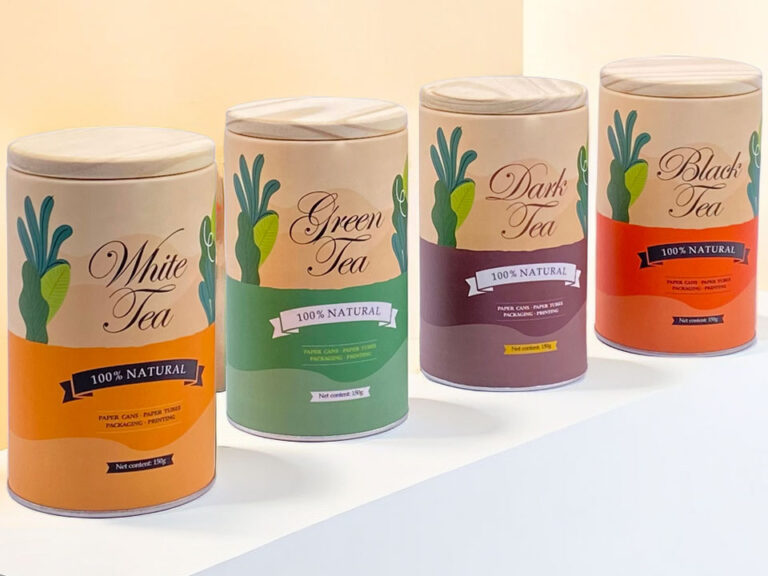
Une bonne référence est le tube à thé avec un couvercle en fer blanc : emballage de tubes de thé en papier. La page mentionne un ajustement serré, un pelliculage mat et des accents en aluminium, ce qui contribue à la fois à la performance de la barrière et à l'aspect du produit en rayon.
Emballage en tube de papier pour protéines en poudre
Les emballages de protéines en poudre sont jetés dans les sacs de sport, expédiés en vrac et empilés dans les entrepôts. Les éraflures, les empreintes digitales et les bosses sont les points sensibles habituels.
L'exemple du tube de protéines en poudre montre un cylindre laminé mat avec des détails en papier d'aluminium chaud : tubes en papier pour protéines en poudre. Le pelliculage mat fait ici un véritable travail : il réduit les reflets, dissimule les marques de manipulation et permet à l'emballage de rester propre plus longtemps.
Emballage en tube de papier pour les cosmétiques
Les acheteurs de produits cosmétiques jugent rapidement. Votre tube doit protéger le produit, mais il doit aussi avoir l'air coûteux sans être surdimensionné.
Cet exemple de tube cosmétique utilise un noyau rigide avec une impression offset et un marquage à chaud : tubes en papier pour cosmétiques. Il s'agit d'une structure classique “premium mais simple” qui fonctionne pour les sérums, les crèmes et les petits articles de beauté.
Emballage en tube de papier résistant aux enfants
Les catégories réglementées exercent une pression différente : sécurité, attentes en matière de conformité et moins de “seconde chance” en cas de réclamation de la part des clients.
L'exemple de sécurité enfant comprend une paroi transparente et un support en mousse : tubes en papier à l'épreuve des enfants. Ce support en mousse fait un travail discret et pratique : il maintient le produit centré, réduit les bruits et contribue à réduire les réclamations pour dommages.
Boîtes en tube de papier pour les cartouches de CBD
Les cartouches sont petites, mais l'emballage doit être performant. Un emballage mal ajusté et des rayures pendant le transport peuvent donner lieu à des remboursements et à de mauvaises critiques.
Ce tube cartouche utilise un noyau rigide avec un pelliculage mat et des détails en aluminium : boîtes en papier pour cartouches CBD. Il s'agit d'une solution propre pour les marques qui souhaitent une présentation adaptée à la vente au détail et une expédition plus sûre.
Emballage en tube de papier pour bijoux
L'emballage d'un bijou a une fonction : donner l'impression qu'il s'agit d'un cadeau à la seconde où quelqu'un le tient en main. Les empreintes digitales, les éraflures et la “sensation de couvercle bon marché” gâchent ce moment.
Le tube à bijoux blanc mat avec un nœud en est un bon exemple : boîte à bijoux en papier. La surface mate permet d'éviter les bavures, et le ruban en fait un emballage prêt à être offert.
Emballage en tube de papier imprimé double face
Si vous souhaitez dévoiler un produit haut de gamme sans modifier la structure de base, imprimez l'intérieur. C'est un geste simple qui donne à l'unboxing l'impression d'avoir été conçu.
Les spécifications d'emballage des tubes en papier qui comptent vraiment
Épaisseur de la paroi et résistance à l'écrasement
Si les clients reçoivent des tubes cabossés, il s'agit généralement de dommages dus à la compression, Il ne s'agit pas d'une “malchance”. Il faut y remédier avec une paroi plus épaisse, un noyau plus solide ou un meilleur plan d'insertion afin que le produit ne transfère pas l'impact au corps du tube.
Ajustement du couvercle, friction et contrôle du cliquetis
Un couvercle mal fixé nuit à la confiance. Il crée également des cliquetis, ce qui donne l'impression que l'ensemble du paquet est bon marché. Vous pouvez renforcer l'expérience en contrôlant l'ajustement, en ajoutant un insert et en choisissant une construction qui favorise une tolérance stable.
Pelliculage mat, impression offset et détails à chaud
Les finitions ne sont pas qu'une simple décoration. Le pelliculage mat permet de réduire les éraflures et les empreintes digitales. L'impression offset permet de conserver la netteté des détails. La dorure ajoute une touche haut de gamme que les acheteurs remarquent rapidement, en particulier dans les secteurs de la beauté et du bien-être.
Comment choisir l'emballage d'un tube en papier
Voici un moyen simple de choisir la bonne direction sans se compliquer la vie :
Si vous expédiez directement au consommateur, La résistance à l'écrasement et le contrôle des éraflures sont des priorités. Le pelliculage mat et les parois plus résistantes sont rentabilisés par la diminution des réclamations “arrivé endommagé”.
Si vous vendez un produit haut de gamme, Les clients remarquent l'ajustement et la finition avant même de lire le moindre mot sur l'étiquette. Les clients remarquent l'ajustement et la finition avant de lire un seul mot sur l'étiquette.
Si votre produit peut se déplacer à l'intérieur du tube, Pour ce faire, il faut ajouter un encart. Le cliquetis est un aimant à retour.
Si vous travaillez dans le domaine de l'alimentation, du thé ou des arômes, Pour les produits de la mer, il faut d'abord penser à la barrière. Cela signifie une protection de la surface, des fermetures plus propres et des matériaux qui restent présentables après le stockage.
Boîtes en papier tubulaire personnalisées OEM/ODM
Si vous achetez pour une marque, un distributeur ou un programme de marque privée, vous n'avez pas seulement besoin d'un “tube”. Vous avez besoin d'un système reproductible : structure + finition + impression + encarts + production régulière pour les gros tirages.
C'est là que l'assistance OEM/ODM est utile. Vous pouvez vous aligner sur les spécifications une fois, échantillonner rapidement, puis passer à des commandes en gros sans avoir à réinventer le paquet à chaque fois.
Pour commencer par la porte d'entrée de la marque, utilisez la page d'accueil du site : Boîtes en papier tubulaire fabriquées sur mesure. Puis sautez dans le Produits pour établir une liste restreinte des styles de tubes qui correspondent à votre UGS et à votre canal de vente.