Vous n'avez toujours pas trouvé la bonne solution d'emballage ? Parlez-en à notre patron.
Si vous avez consulté notre site web ou discuté avec le service des ventes et que vous ne voyez toujours pas la voie à suivre, envoyez votre demande ici. Votre message sera transmis directement à notre directeur général, qui examinera la faisabilité, le coût et le délai de mise en œuvre. Vous obtiendrez une étape suivante claire - ce que nous pouvons faire, ce que nous attendons de vous, et la voie la plus rapide pour obtenir un devis.
Examen direct par GM de vos spécifications, cas d'utilisation et contraintes
Vérification de la taille et de la structure : diamètre, hauteur, résistance des parois, inserts
Recommandations en matière d'impression et de finition en fonction de la marque et du budget
Possibilités de réduction des coûts et d'amélioration des délais
Clarté du cheminement du devis : MOQ, plan d'échantillonnage et étapes suivantes
Parler à notre patron
Obtenir un devis rapide pour l'emballage de tubes en papier sur mesure
Conçu pour les responsables de l'emballage, de l'approvisionnement et les ingénieurs de l'emballage. Spécifiez la taille, la quantité et la finition pour obtenir un devis, un délai de livraison et des conseils sur les spécifications pour les programmes américains/européens.
Personnalisation prête à l'emploi : diamètre, hauteur, épaisseur de paroi, inserts, doublures et fermetures
Finitions haut de gamme : CMYK/Pantone, film, gaufrage, UV
Clarté de l'approvisionnement : spécifications claires + conseils en matière de contrôle de la qualité et de gestion des défauts de fabrication
Durable : Papier FSC® disponible sur demande
Sécurité enfants : conforme à la norme ISO 8317 / PPPA
La révolution de l'expérience dans la conception des emballages en tube de papier : l'évolution des contenants écologiques vers des supports émotionnels
Table des matières
L'emballage en tube de papier était autrefois un “contenant meilleur pour la planète”. Cet argument est toujours d'actualité. Cependant, les acheteurs ne s'arrêtent plus aux allégations écologiques. Ils veulent que l'emballage vendre, expliquer, protéger, et sentir comme la marque.
C'est pourquoi les tubes en papier passent du statut de “boîte contenant un produit” à celui de médias émotionnels. Le tube devient une mini-scène : la prise en main, le glissement, l'éclatement, la révélation, la réutilisation. S'il est bien fait, il permet d'augmenter la mise en rayon, d'améliorer le contenu de l'emballage et de réduire les critiques du type “ça a l'air bon marché”.
Si vous vous approvisionnez à grande échelle, vous avez également besoin d'un fabricant capable de respecter des tolérances strictes et de produire en grande quantité sans problème. Votre site vous positionne en tant que Boîtes en papier tubulaire fabriquées sur mesure, en soutenant OEM/ODM, L'entreprise dispose d'un atelier moderne de purification des emballages alimentaires, d'un grand entrepôt et d'une production journalière élevée. C'est le genre d'informations que les équipes chargées des achats aiment entendre avant de signer.
Tableau de preuves pour la conception de l'expérience de l'emballage des tubes en papier
Vous avez demandé un soutien professionnel, voici donc un tableau de preuves que vous pouvez réutiliser dans vos présentations de vente. Il évite les liens externes tout en gardant les sources claires.
Demande d'expérience (ce que vous pouvez dire)
Signification pratique pour les tubes en papier
Valeur commerciale (pourquoi les clients se sentent concernés)
Source de la preuve (pas de liens externes)
Le papier/carton est souvent synonyme de “naturel” et de “confiance”
Le choix des matériaux peut améliorer la qualité perçue lorsque la finition correspond à l'histoire.
Conversion plus élevée, moins de barrières de confiance pour le bien-être/l'alimentation
Recherche évaluée par les pairs sur la perception des emballages alimentaires en papier par les consommateurs (journal MDPI)
Les emballages multisensoriels influencent l'attention et la valeur perçue
Le toucher + le rituel d'ouverture + le son peuvent faire partie de la mémoire de la marque
Meilleure mémorisation, plus grande “sensation de qualité”, plus d'actions
Collection évaluée par les pairs sur l'expérience multisensorielle de l'emballage (volume Elsevier/ScienceDirect)
Les emballages à base de papier peuvent nécessiter des améliorations de la barrière pour l'arôme/l'humidité.
Utiliser des doublures, des revêtements et une meilleure conception des fermetures pour les produits sensibles
Moins de plaintes, moins de risques de fuite, plus de catégories de produits adaptées
Revues évaluées par les pairs sur les barrières d'emballage alimentaire à base de papier (Elsevier/ScienceDirect review articles)
Un emballage créatif peut susciter la curiosité et un engagement plus profond
Les astuces structurelles incitent les clients à ralentir et à interagir
Plus grande prise en charge en rayon, temps de surveillance plus important lors du déballage
Étude évaluée par les pairs sur la créativité des emballages et la curiosité des consommateurs (Journal of Business Research)
La conception de symboles culturels influe sur l'expérience → la valeur perçue → l'intention d'achat
Les signaux culturels sont plus efficaces lorsqu'ils sont intégrés dans une structure et un rituel.
Une meilleure performance en matière de cadeaux, une identité locale plus forte
Étude évaluée par les pairs utilisant le modèle SOR sur la conception de métaphores de symboles culturels (PLOS ONE)
Le QR/AR fait de l'emballage un point de contact numérique
Scan-to-learn, authenticité, onboarding, histoire de la marque
Moins de retours, une meilleure éducation, une plus grande confiance
Recherche évaluée par les pairs et littérature industrielle sur l'interaction entre les emballages AR/QR
Emballage des tubes en papier et expérience du consommateur
Les tubes en papier présentent deux avantages indéniables :
Contraste de forme: des cylindres se détachent d'un mur de rectangles.
Sensation de la mainles gens les prennent naturellement, les font tourner et testent le couvercle.
Ce comportement est important pour le commerce de détail et pour D2C. Dans le commerce de détail, il stimule le ramassage et le temps passé en rayon. Dans le domaine du D2C, il transforme le moment du déballage en contenu.
Du point de vue de l'acheteur, les points douloureux sont prévisibles :
“Pouvez-vous maintenir l'ajustement des couvercles constant d'un lot à l'autre ?”
“L'impression risque-t-elle d'être abîmée pendant le transport ?”
“Est-ce que ce produit répondra aux exigences de conformité pour les catégories réglementées ?”
“Pouvez-vous traiter les commandes OEM/ODM et les grandes séries sans que les délais de livraison ne soient chaotiques ?”
C'est là qu'un fabricant à guichet unique est utile. Il réduit les transferts, les reprises et évite que le projet ne se transforme en une chaîne de blâme.
Emballage multisensoriel et expérience de déballage
Un tube en papier est fondamentalement un dispositif multisensoriel. Les clients le voient, le saisissent, le tournent, le font glisser et l'entendent s'ouvrir. Cette séquence détermine ce qu'ils ressentent à l'égard du produit qu'il contient, avant même de l'essayer.
Expérience de déballage et valeur perçue
Si votre client vend des articles haut de gamme, le tube doit être “serré” dans le bon sens du terme : frottement contrôlé, bords nets, pas de cliquetis. Ce n'est pas du vent. C'est de l'ingénierie de la valeur perçue.
Des idées d'unboxing basées sur des scènes qui fonctionnent dans des commandes réelles :
Extérieur : calme, image de marque minimale.
A l'intérieur : couleurs vives ou impression d'histoires.
Insert : le produit est centré et ne rebondit pas.
Fermeture : glissière lisse, joint satisfaisant.
Pour les marques de produits de beauté, ce style convient parfaitement : tubes en carton pour cosmétiques personnalisés. Il prend en charge une révélation de qualité supérieure sans nécessiter de pièces compliquées.
Récit tactile de matériaux respectueux de l'environnement
La durabilité n'est pas une simple affirmation. C'est un sentiment. Les tubes en papier vous permettent de transformer l'histoire écologique en quelque chose que les clients peuvent toucher.
L'astuce consiste à concevoir l'expérience matérielle de manière ciblée :
Utilisez la texture de la fibre lorsque vous souhaitez obtenir un résultat naturel.“
Utilisez un pelliculage soft-touch ou mat lorsque vous recherchez le “luxe”.”
Utiliser l'embossage/débossage pour une reconnaissance du bout des doigts.
Contrôle de la résistance aux éraflures pour que l'emballage ait l'air neuf à l'arrivée.
Le papier/carton est associé à la confiance et au naturel.
Dans l'esprit des consommateurs, le papier est souvent synonyme de “plus propre, plus sûr, plus proche de la nature”, en particulier dans le domaine de l'alimentation et du bien-être. Cela vous donne une longueur d'avance. Cependant, vous devez toujours faire correspondre l'apparence à la promesse.
Exemples de bonnes correspondances
Huiles essentielles : papier calme, mat, tactile.
Compléments : graphiques propres, pas de motifs bruyants.
Thé biologique : indices kraft, fermeture hermétique, signal de fraîcheur.
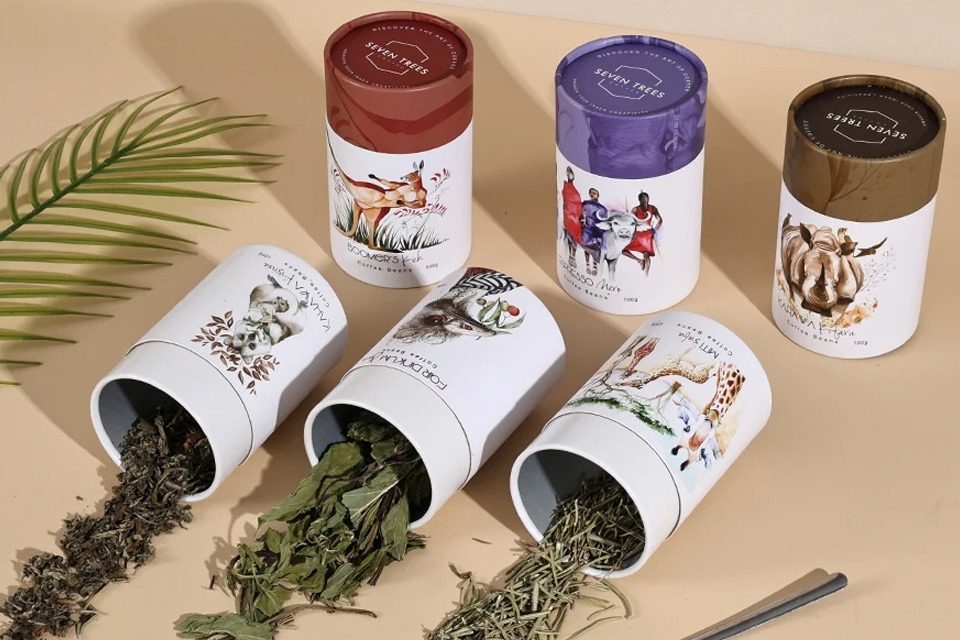
Pour un cas d'utilisation de thé qui vend à la fois des produits de qualité alimentaire et des produits à offrir, ce type de produit est parfaitement adapté : tubes de papier à thé avec couvercle en fer blanc.
Emballages à haute barrière à base de papier
Certains produits ont besoin de plus qu'une belle surface. Ils ont besoin d'une barrière performante. Le papier seul peut avoir du mal à résister à l'humidité, à l'oxygène et aux arômes. C'est là que les choix de structure sont vraiment utiles.
Des choix qui permettent d'aller de l'avant et de conserver l'histoire du papier
Doublures intérieures pour les produits sensibles aux arômes
Meilleur ajustement de la fermeture pour réduire les micro-écarts
Des revêtements qui concilient les objectifs de protection et de recyclabilité
Conception d'emballages interactifs et gamification
Si vous voulez plus de partage social et une meilleure rétention, donnez aux clients quelque chose à faire. Une structure interactive est le moyen le plus simple de créer un “moment” sans ajouter d'électronique.
Créativité du design d'emballage et curiosité du client
La curiosité est désormais un indicateur de performance. Une conception qui semble intelligente incite les gens à ralentir, à regarder plus longtemps et à se souvenir davantage.
Des mouvements structurels à faible risque qui prennent de l'ampleur
Manches à ouverture par torsion
Fenêtre dévoilant la couleur ou la texture
Impression en couches : minimalisme extérieur, histoire intérieure
Incitation à la réutilisation : “Gardez ce tube pour le stockage”
Symboles culturels traditionnels et expérience des clients
Le design culturel est le plus efficace lorsqu'il a un sens et non une fonction décorative. Les marques l'utilisent pour les festivals, les produits touristiques, les collaborations régionales et les cadeaux haut de gamme.
Conception de métaphores et valeur perçue
Les tubes culturels les plus solides ne se contentent pas d'imprimer un modèle. Ils construisent un rituel :
La direction de l'ouverture suit une logique de “cérémonie”.
L'impression intérieure révèle une petite histoire au moment opportun.
Les indices de texture font référence à l'artisanat local, et non à des icônes génériques.
Les cadeaux de bijoux sont parfaitement adaptés, car les acheteurs s'attendent à un cérémonial. Un style épuré et haut de gamme ressemble à ceci : emballage en papier blanc mat pour bijoux.
Réalité augmentée dans l'emballage d'un produit avec un code QR
L'emballage intelligent n'est pas forcément synonyme de capteurs. Un code QR peut déjà transformer le tube en point de contact numérique.
Utilisez des flux d'analyse qui résolvent des problèmes réels :
Vidéos pratiques (réduit les mauvaises utilisations et les retours)
Contrôles d'authenticité (réduction de la crainte de la contrefaçon)
L'histoire d'un ingrédient ou d'un matériau (crée rapidement la confiance)
Guides d'installation (très utiles pour les appareils électroniques)
Emballage intelligent et jumeau numérique
Si vous vendez des produits complexes, les clients vous jugent souvent sur la rapidité avec laquelle ils comprennent le produit. Un flux de type “jumeau numérique” peut vous aider : scanner → apprendre → vérifier → partager.
Pour les articles réglementés ou sensibles, l'association d'un tube solide et de l'éducation numérique est une bonne solution. Exemple de catégorie : Boîtes de tubes en papier pour cartouches CBD.
Conception d'une expérience durable en boucle fermée
La boucle fermée ne nécessite pas de grands discours. Il a besoin de petits choix qui rendent la réutilisation naturelle.
Des actions en boucle fermée que les clients réalisent réellement
Faire en sorte que le tube soit suffisamment résistant pour
Ajouter des invites intérieures pour la réutilisation (rangement, bureau, voyage)
Garder les matériaux simples pour que le recyclage reste simple
Éviter les paquets “Frankenpacks” de matériaux mixtes, sauf si le besoin de barrière est réel.
Lorsque le tube est stocké, vous gagnez une “exposition à la marque” chaque fois que le client le revoit. C'est du marketing discret. Cela ne ressemble pas à de la publicité. Cela ressemble à de l'utilité.
Emballage conforme et options de sécurité pour les enfants
Certaines catégories exigent la conformité, et pas seulement l'esthétique. Une structure à l'épreuve des enfants, des preuves d'effraction et un étiquetage clair peuvent décider le détaillant à accepter le produit.
Si vous vendez des articles liés au cannabis, n'ajoutez pas la conformité à la fin. Commencez par une structure tubulaire conforme, puis appliquez une stratégie de marque par-dessus. Il s'agit d'une correspondance directe : emballage en tube de papier à l'épreuve des enfants.
Liste de contrôle des spécifications d'emballage pour la production de masse OEM/ODM
Un excellent concept peut toujours échouer si la production de masse dérive. Voici une liste de contrôle pratique que vous pouvez utiliser avec les acheteurs en gros, les grossistes et les propriétaires de marques :
Tolérance d'ajustement : étanchéité du couvercle, contrôle de l'oscillation, répétabilité
Durabilité de la surface : anti-éclaboussures, résistance aux frottements, usure due à l'expédition
Contrôle de l'impression : attentes en matière de couleurs, alignement, placement des coutures
SKU scaling : plan de kitting, traitement des variations, points de contrôle du contrôle qualité
Cette liste de contrôle aborde directement les problèmes rencontrés par les acheteurs. Elle vous positionne également comme un fabricant qui comprend la réalité de la conception et de la production.