Still Not Seeing The Right Packaging Solution? Talk to Our Boss.
If you’ve reviewed our website or spoken with sales and still don’t see a clear path, send your request here. Your message goes directly to our General Manager for an executive review of feasibility, cost, and lead time. You’ll get a clear next step—what we can do, what we need from you, and the fastest route to a quote.
Built for packaging managers, procurement, and packaging engineers. Specify size, quantity, and finish to receive moq, lead time, and spec guidance for us/eu programs.
Quote-ready customization: diameter, height, wall thickness, inserts, liners, and closures
Indian Spice Paper Tube Packaging: Design, Freshness & Shelf Appeal
Indian spices present an unusual packaging challenge. Turmeric, chilli powder, cumin, garam masala and regional seasoning blends need protection from moisture, oxygen, light and repeated opening, yet the package also has to distinguish dozens of similar SKUs on a crowded retail shelf.
Paper tubes can solve the structural and branding side of that problem, but the paperboard cylinder alone should not be treated as the freshness barrier. For professional buyers, the real specification is a system: rigid tube body, food-contact layer, barrier liner, initial seal, closure and dispensing mechanism.
That distinction matters as Indian spices move through increasingly international supply chains. India’s Spices Board reports that the country exported about 1.734 million tonnes of spices and spice products worth US$4.43 billion in 2025–26, with the United States accounting for the largest individual destination share at 14% of export earnings. Packaging therefore has to work not only on a retail shelf, but through filling, warehousing, ocean or air freight, distribution and destination-market compliance.
Why Spice Paper Tube Packaging Requires More Than a Rigid Cylinder
A paper tube provides three useful functions immediately: shape retention, light blocking and a large printable surface. Those are valuable attributes, but they do not automatically make the package suitable for direct contact with ground spices.
A typical spice paper tube may contain several functional components:
a multi-ply paperboard body;
a printed outer wrap;
an internal paper, polymer or foil-based barrier;
an end closure;
a peel membrane or other tamper-evident seal;
an optional shaker or sifter;
adhesives connecting structural components.
For buyers evaluating custom spice and salt paper tubes, the useful question is therefore not simply, “How thick is the cardboard?” It is, “What complete packaging structure protects this particular spice from filling through end use?” The category includes applications for seasonings, herbs and salts with configurable liners, closures and dispensing options.
Thicker paperboard does not automatically mean fresher spices
This is one specification mistake worth challenging.
Higher wall strength can improve resistance to crushing, improve the feel of the package and support stacking. It does not necessarily produce a meaningful improvement in moisture- or oxygen-barrier performance.
A heavy rigid tube with a weak liner and loose-fitting lid may preserve aroma less effectively than a lighter tube combined with an appropriate barrier and well-designed seal.
For a spice brand, board strength and barrier performance should therefore be specified as separate engineering requirements.
What Actually Protects Spice Freshness?
Spices can deteriorate through several mechanisms. Moisture can cause powders to agglomerate or clump. Oxygen exposure can reduce aroma quality. Light may affect sensitive natural pigments. Repeated opening adds another variable because the consumer repeatedly exchanges the package headspace with ambient air.
The packaging structure should consequently be matched to the spice rather than standardized blindly across every SKU.
A 2026 study involving researchers from the Indian Institute of Packaging compared barrier structures for fenugreek and fennel. Under the study conditions, the PET AlOx/PE structure tested provided estimated shelf lives of 459 days for fenugreek and 504 days for fennel. The specific numbers should not be generalized to every spice or package, but the study illustrates the larger point: measurable moisture and oxygen barrier properties can materially affect spice shelf-life performance.
Do not assume the paper wall alone provides adequate moisture or aroma protection
Paper tube with barrier-coated inner layer
Low to medium/high depending on coating
Dry spices and blends where validated coating performance meets the target
Can reduce complexity compared with some multilayer structures
Request actual food-contact and barrier data rather than relying on “coated” as a specification
Foil or foil-laminate barrier with sealed top
High potential
Aromatic powders, hygroscopic blends, longer distribution chains
Strong moisture, oxygen and light protection
Multi-material construction may complicate recycling and separation
Paper tube containing a separate sealed inner pouch
Determined mainly by pouch
Premium spices, refill systems, gift products
Separates structural packaging from primary barrier function
More components, additional filling steps and higher material use
Barrier-lined tube with membrane seal and shaker closure
High potential when engineered correctly
Retail chilli, turmeric, seasoning and fine spice powders
Combines initial seal with controlled dispensing
Sifter design, seal fit and particle size must be tested with the actual product
The right structure depends on target shelf life, spice chemistry, particle size, filling environment, climate, distribution route and destination-market requirements. A supplier should be able to explain those dependencies rather than recommend one liner for every spice.
The Initial Seal Matters as Much as the Reclosure
A consumer may associate freshness with the cap, but the initial barrier before first opening is often just as significant.
For retail spice packaging, consider separating two functions:
Initial protection: a peelable membrane, sealed foil or comparable system protects the unopened spice during transport and retail storage.
After-opening dispensing: a sifter, shaker top or controlled-pour closure governs consumer use after that initial seal has been removed.
A kraft spice tube with a paper sifter demonstrates how dispensing can be integrated into a paper-based cylindrical structure rather than added as an afterthought.
That does not mean every spice should use the same perforation pattern.
Match the sifter to the spice
Fine turmeric powder, coarse black pepper, sesame-based seasoning and flaky chilli blends have different flow characteristics. Hole diameter, number of holes, spacing and opening area affect:
dispensing rate;
risk of bridging;
consumer dose control;
clogging;
accidental over-pouring.
A shaker-sifter powder tube shows the mechanical principle of controlled dispensing in a rigid paper cylinder. If that architecture is adapted to food, however, the complete food-contact specification should be validated rather than inferred from the physical design alone.
Consumer discussions also repeatedly describe fine spice powders becoming difficult to shake after exposure to humidity. Those anecdotes are not laboratory evidence, but they are useful reminders that flowability, closure performance and moisture protection affect the real user experience after the product leaves the factory.
Food-Contact Compliance Must Cover the Complete Material Stack
“Paper” and “food grade” are not interchangeable terms.
If the paper, liner, adhesive, coating or closure is intended to contact the spice, the applicable food-contact requirements need to be defined for the destination market.
For Indian-market packaging, the current FSSAI Packaging Regulations state that materials coming into direct or likely contact with food must be food grade. The regulations also require printed surfaces not to come into direct contact with food and specify requirements for paper and board used as primary food packaging. They additionally require a certificate of conformity from an NABL-accredited laboratory for packaging materials that come into direct or likely contact with food.
FSSAI’s paper-and-board schedule references standards covering materials including grease-proof paper, aluminium-foil laminates, general-purpose packing paper and uncoated folding box board.
For export programs, specify the destination country at RFQ stage. A supplier cannot determine compliance intelligently if the brief says only “food grade.”
Ask suppliers for component-level documentation
A serious RFQ should identify or request documentation for:
food-contact liner;
coating;
membrane;
adhesive where relevant;
closure or sifter;
printing ink system;
intended spice type;
direct versus indirect food-contact surfaces.
This becomes especially relevant when sustainability claims are part of the project.
In the United States, for example, the FDA announced in 2024 that PFAS-containing grease-proofing substances were no longer being sold for food-contact use in paper and paperboard packaging, and in January 2025 it determined that 35 associated Food Contact Notifications were no longer effective.
“Moisture resistant” should therefore never be interpreted as permission to use an unspecified coating.
How Should Indian Spice Packaging Create Shelf Appeal?
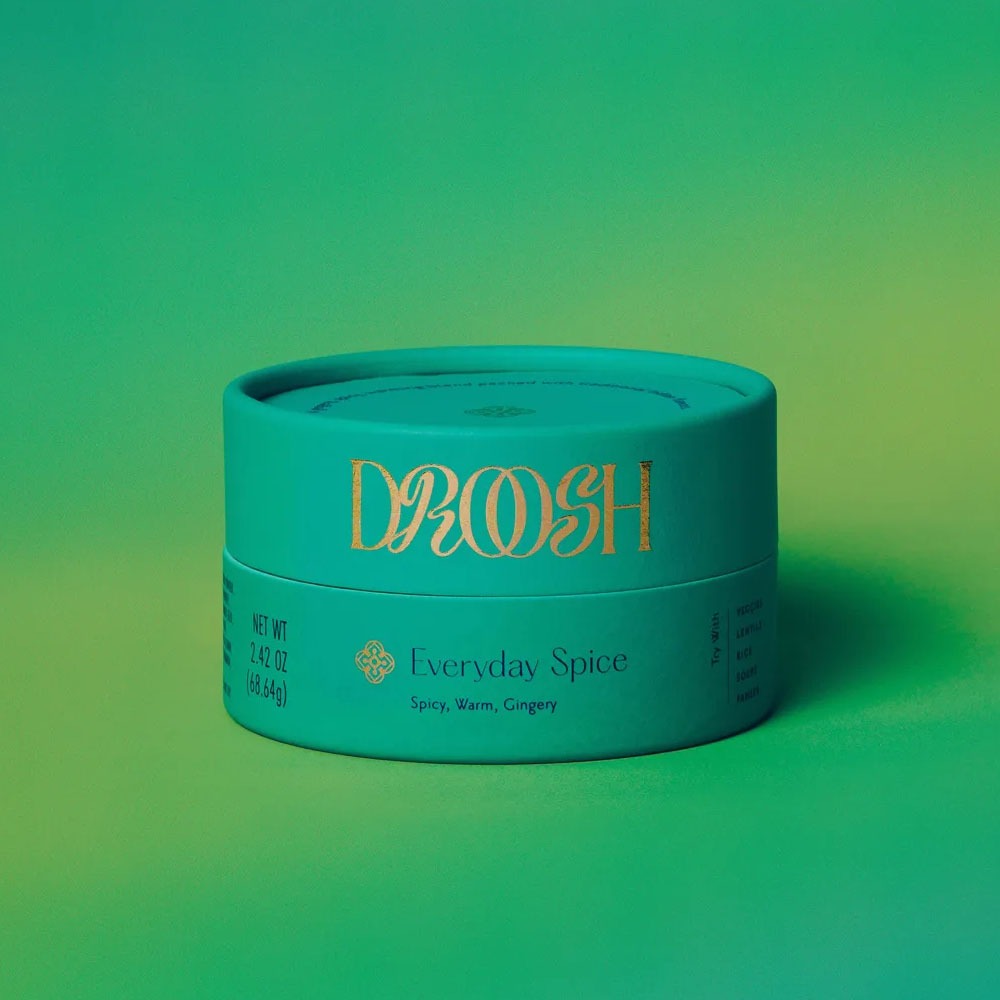
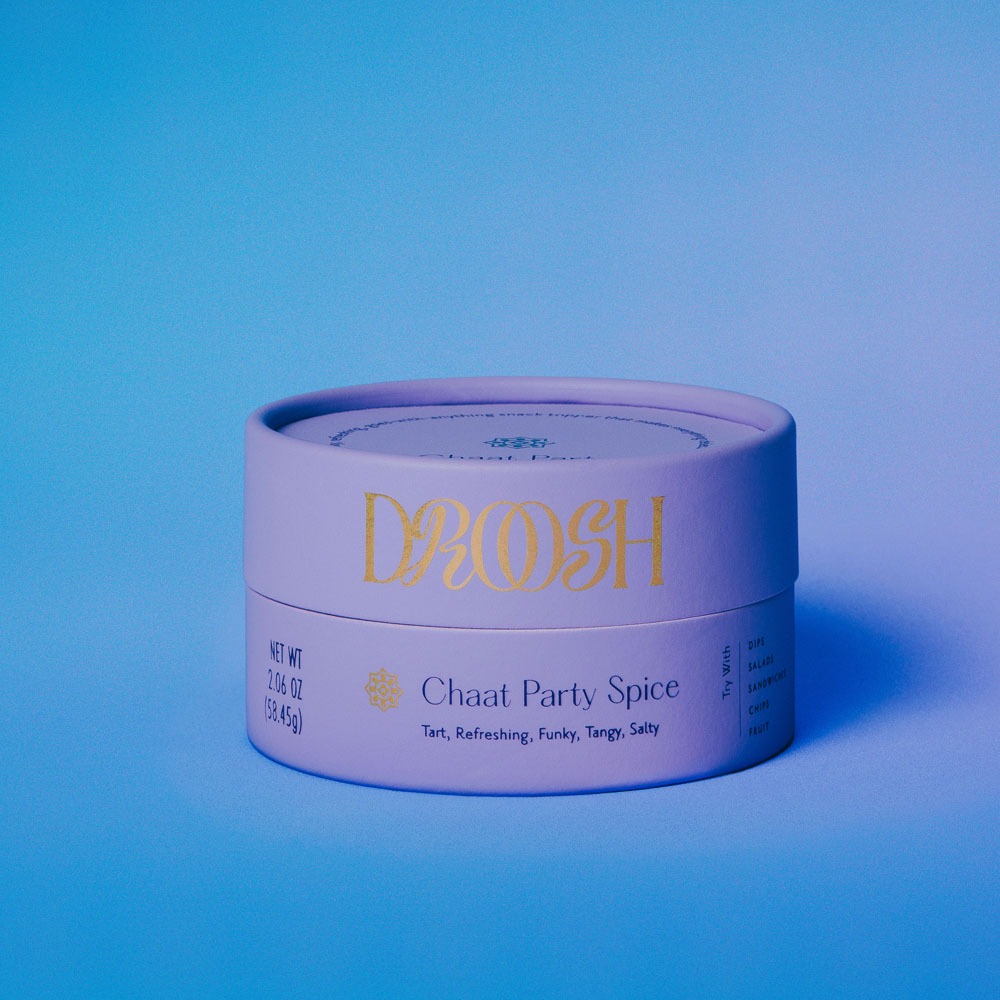
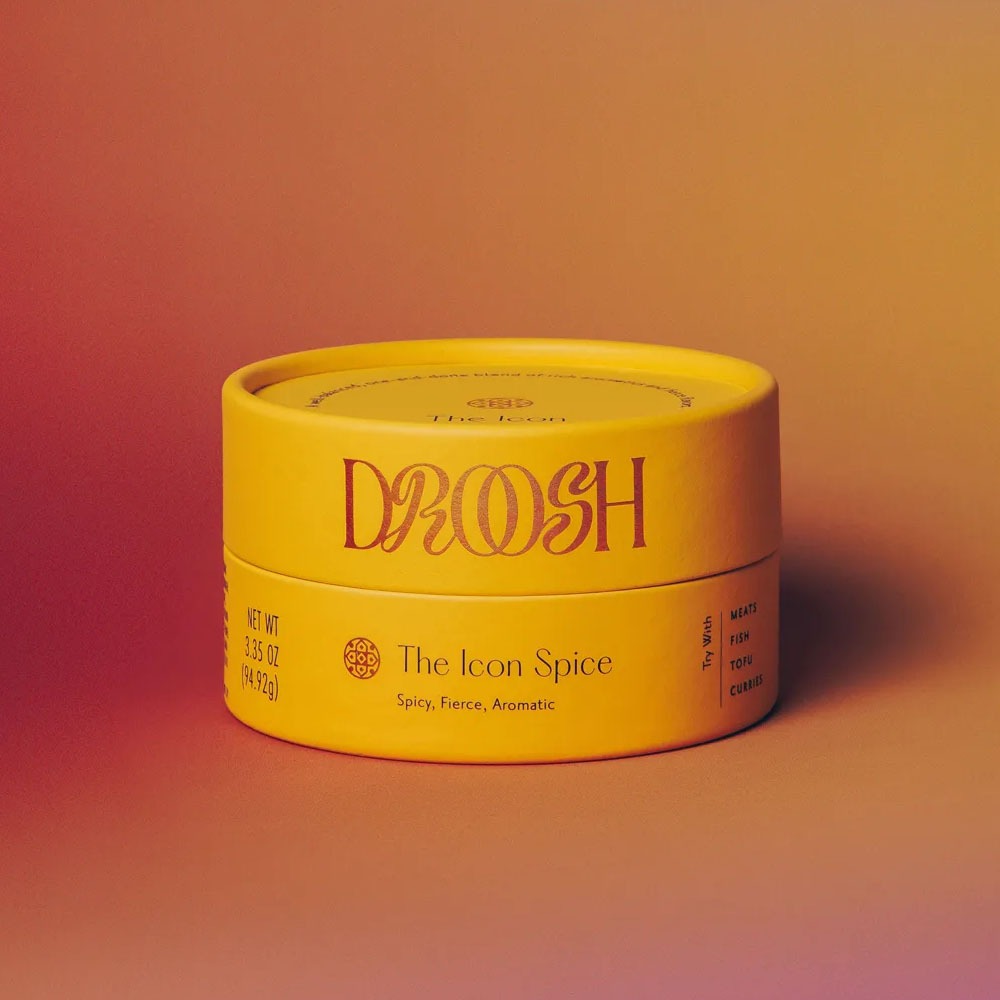
Indian spice shelves tend to carry many visually similar products: chilli, turmeric, coriander, cumin, pepper, curry powders and multi-ingredient masalas. A cylindrical package gives designers more surface area than a small conventional sachet, but that surface needs hierarchy.
Build a scalable SKU system
A stronger system usually separates information into layers:
Brand level: logo, master typography and visual architecture remain consistent.
Product-family level: pure spices, regional blends, cooking masalas or premium single-origin products can have distinct design systems.
SKU level: color coding, product name, spice illustration or photography helps buyers differentiate turmeric from chilli or garam masala quickly.
Information level: net quantity, ingredients, origin, usage instructions, regulatory information, barcode and traceability details should remain readable rather than being buried beneath decorative graphics.
Color can accelerate recognition, but it should not become the only identifier. A red cylinder may suggest chilli, but typography still has to communicate exactly which chilli variety or blend the shopper is holding.
Use Indian visual language selectively
Traditional motifs, regional patterns and origin cues can support authenticity, particularly for heritage or regional spice brands. Using every available cultural symbol at once usually weakens rather than strengthens the communication hierarchy.
Premium packaging can sometimes become more distinctive by reducing decoration and emphasizing:
spice origin;
harvest region;
blend purpose;
flavor profile;
heat level;
preparation instructions;
ingredient transparency.
That approach is especially useful for Indian spice brands entering markets where shoppers may recognize “turmeric” but not immediately understand terms such as chaat masala, panch phoron or a region-specific curry blend.
Paper Tubes Can Also Support Premium and Gift Spice Formats
Not every spice cylinder needs a shaker.
Whole spices, saffron, cardamom selections, regional collections and festive seasoning assortments may benefit more from presentation-oriented tubes or multi-product sets.
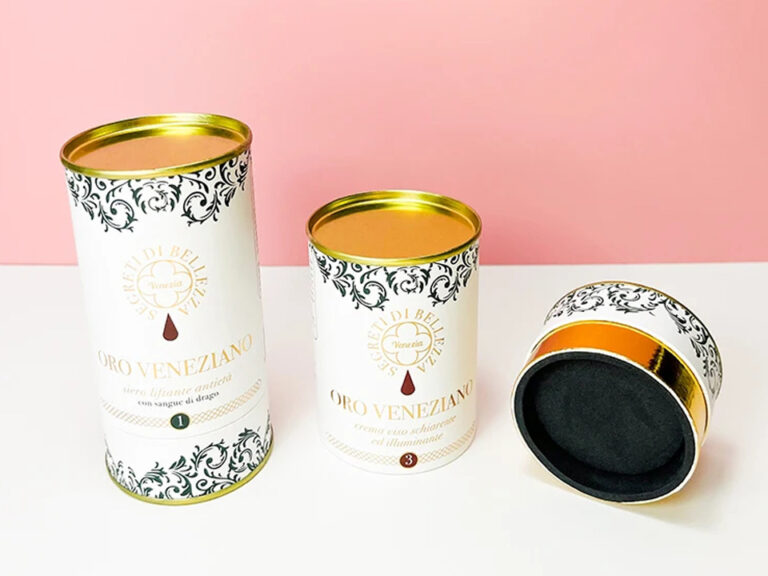
The structural idea used in round food gift tube packaging—a rigid circular presentation pack with a fitted tray—can provide useful inspiration for premium spice assortments, provided the primary spice packs themselves have suitable food barriers.
For gift applications, the tube may act primarily as secondary packaging while the spice remains inside sealed jars, pouches or sachets. That separation can make engineering easier: the inner package handles freshness while the outer tube handles presentation and protection.
A Paper Appearance Does Not Automatically Make the Package Easy to Recycle
Paper-forward packaging can reduce the visible amount of plastic, but buyers should examine the entire construction before making recycling claims.
Possible non-paper components include:
foil liners;
polymer coatings;
plastic sifter inserts;
metal ends;
laminated decorative films;
adhesives;
peelable membranes.
A food-grade spice paper tube format can be designed around a rigid paper core and customized liner, but those inner components determine much of the package’s actual barrier and end-of-life profile.
A better sustainability discussion therefore asks three separate questions:
How much fiber versus non-fiber material is used?
Can the components be separated easily?
Will the resulting structure be accepted by the relevant recycling system?
The package that looks most natural is not necessarily the package with the simplest material recovery route.
What Should Be Tested Before Mass Production?
A visual mockup is insufficient for spice packaging.
Before approving mass production, evaluate a production-representative sample with the actual product wherever possible.
Filling and dimensional fit
Check:
intended net weight;
actual bulk density;
required headspace;
tube internal diameter;
total fill height;
filling-line compatibility.
A 100 g pack of one ground spice may not occupy the same volume as 100 g of another.
Dispensing performance
Run multiple dispensing cycles with the intended spice.
Check whether the powder:
exits too rapidly;
bridges over the sifter;
cakes around the openings;
accumulates around the cap;
leaks during transport.
Seal integrity
Inspect the membrane after application and after transport simulation. A premium printed tube has little value if the initial seal lifts at the edge.
Tube and closure fit
Tolerance control affects cap retention, opening force and perceived quality. The buyer should establish acceptable dimensions rather than approving only the artwork.
Print consistency
For a 10- or 20-SKU spice family, color drift can damage shelf consistency. Pantone references, approved color standards and mass-production samples become more important as the range expands.
Transport performance
Paper tubes can resist crushing well, but evaluate the packed shipping configuration, not the empty tube in isolation. Carton arrangement, pallet loading, humidity exposure and freight route all influence results.
A recent r/Packaging discussion illustrates another practical sourcing issue: a buyer evaluating paper tubes faced paid custom sample charges and questioned whether sampling multiple suppliers was worth the cost. Community responses generally favored narrowing the supplier list and investing in representative samples before committing to mass production. That is qualitative advice rather than a standard, but it reflects sound procurement logic for a customized package.
What Drives the Cost of Custom Spice Paper Tubes?
Unit price is influenced by more than tube diameter and order quantity.
Common cost drivers include:
RFQ variable
Why it affects cost or risk
Diameter and height
Changes paper consumption, tooling compatibility, carton count and freight efficiency
Tube wall construction
Influences rigidity, weight and material consumption
Barrier liner
Can materially change both performance and unit cost
Peel membrane or sealing system
Adds components and may require specific filling/sealing equipment
Sifter or shaker
Adds tooling/components and requires product-flow testing
Printed outer wrap
Artwork complexity, colors and print method affect setup
Foil, embossing, spot UV or lamination
Adds converting steps and may affect recyclability
Order quantity per SKU
Important when a brand has many spice variants rather than one large run
Packing method
Individual bags, dividers, master-carton configuration and palletization affect landed cost
Destination
Freight, testing requirements and compliance documentation vary by market
This is why the cheapest quoted tube can produce the higher total cost. A lower unit price loses its advantage if the package creates powder leakage, print rejects, poor pallet utilization or a repeat tooling cycle.
For buyers comparing suppliers, evaluate total landed packaging cost plus quality risk, not just EXW price per piece.
Common Specification Mistakes to Avoid
Specifying “800 GSM” and assuming the job is engineered
GSM can describe part of the paper structure, but it does not define barrier performance, finished wall thickness, moisture protection, crush strength or closure fit by itself.
Using one sifter design for an entire spice family
Cumin powder and coarse herb blends may require different dispensing geometries.
Finalizing graphics before tube dimensions
Changes to circumference, lid depth or seam positions can force artwork revisions. Confirm the production dieline first.
Treating matte lamination as a freshness barrier
Outer surface finishing protects or decorates the printed wrap. It should not be confused with the inner food barrier.
Asking only for a digital mockup
A rendered cylinder cannot demonstrate opening force, seal performance, spice flow, odor retention or crush resistance.
Making vague environmental claims
Define whether “sustainable” refers to recycled content, responsibly sourced fiber, plastic reduction, recyclability, weight reduction or another measurable characteristic.
What Should Buyers Specify Before Requesting a Quote?
A precise RFQ produces more comparable quotations and reduces sampling revisions.
At minimum, provide:
spice or seasoning type;
whole, granulated or powdered format;
net fill weight;
approximate bulk density if known;
preferred tube diameter and height, or product volume;
direct-food-contact requirement;
barrier objective;
liner preference if already specified;
peel seal or other tamper-evident requirement;
sifter or pour-top requirement;
expected order quantity per SKU;
number of artwork variants;
printing colors and finish;
destination market;
target launch date;
packing and freight requirements.
If shelf life is a defined commercial requirement, include it in the brief rather than expecting the tube supplier to infer it. The packaging structure can then be evaluated against the product and distribution conditions instead of being chosen by appearance alone.
The strongest Indian spice paper tube is therefore not necessarily the thickest, most heavily finished or most expensive design. It is the configuration in which barrier performance, dispensing, food-contact compliance, production tolerances, branding and landed cost have been specified as one system.
Frequently Asked Questions
Are paper tubes suitable for ground Indian spices?
Yes, provided the tube uses an appropriate food-contact barrier and sealing system. Paperboard supplies structure and light protection, while the liner and seal normally perform most of the moisture- and oxygen-control work.
Do spice paper tubes need an inner liner?
For many direct-contact ground-spice applications, a suitable barrier layer is advisable. The required material depends on the spice, shelf-life target, climate, filling process and destination-market food-contact requirements.
Can paper tubes keep turmeric and chilli powder fresh?
They can form part of an effective freshness system, but performance depends on barrier properties and seal integrity. Buyers should not assume a rigid paper cylinder alone provides sufficient protection against humidity or oxygen.
What closure is best for spice paper tube packaging?
A tamper-evident initial membrane combined with a reclosable lid or correctly sized sifter is a practical retail configuration. The optimal closure depends on whether the product is a fine powder, coarse seasoning or whole spice.
Are paper spice tubes recyclable?
Potentially, but recyclability depends on the complete construction. Foil liners, polymer coatings, plastic sifters, metal components and laminated finishes can affect separation and acceptance by local recycling systems.
What information should I send a supplier for a spice tube quotation?
Provide spice type, fill weight, dimensions, quantity per SKU, liner/barrier requirements, closure, sifter, printing, finishes, food-contact market, packing method and destination. A physical product sample can also improve dimensional and dispensing decisions.
Should every spice SKU use the same paper tube size?
Not necessarily. Standardizing diameter can simplify sourcing and artwork, but differences in bulk density, fill weight and dispensing behavior may require different heights, headspace or sifter configurations.